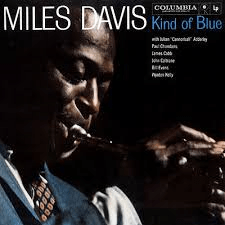
 There was a documentary a while ago on 1959 as the year that changed jazz for ever. It focused on Miles’ Kind of Blue, Brubeck’s Time Out, Mingus’ Ah Um and Coleman’s Shape of Jazz to Come.
Of course, jazz had pretty much become set as bebop/hard bop, and there was a desire to explore further possibilities. These recordings had profound effects on all kinds of levels and they were iconoclastic in different ways, but I think there’s a common notion linking them. There seemed to be something in the air…
 Kind of Blue was the sound of modal jazz, but can be seen more prosaically as an album based largely on vamps. Adderley’s vaporous intro over bass riff on Autumn Leaves on the earlier Something Else is a significant precursor. So is Bill Evans’ Peace Piece – an extended rumination on the underpinning of Some Other Time. What we have here is tunes based around neutral vamps or “til-readies”, rather than chasing changes. The challenge was to put something meaningful on top.
Though it’s not mentioned in the documentary, the following year’s Giant Steps deserves a mention here. Modulation by major thirds had been used before, classically, in Tin Pan Alley and by jazz composers. Stablemates and Miss Jones are well-known examples. Coltrane took the idea and made an entire tune (and system) out of it. Of course, he went on to do the same with minor thirds and then went further still…
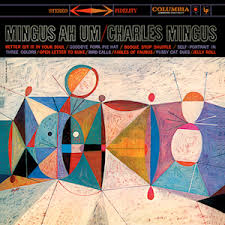
 Mingus’ Ah Um could be regarded as There Is No Such Thing as Genre. Arrangements previously had included clearly delineated stylistic sections – with Mingus’ music the idea seemed to have been to express yourself in any style whenever you like. Just don’t coast, or he’d belt you. Full engagement all the time, no excuses.
Brubeck’s album was all about unorthodox time signatures. It was honestly felt that you could only really swing in 4/4 time (Fats Waller might have disagreed) and Time Out ignited quite a debate. Bear in mind that arrangements had hitherto often contained odd-bar breaks or sections.
As for Coleman – well, essentially what he was doing was liberating jazz from the hamster wheel of cyclical form. Which can be thought of as playing somehow in the spirit of the tune. Everything is essentially a communal cadenza.
 So what do they all have in common? In each case, what had previously been regarded as a small component of music has been expanded to become the whole and opened up for intense exploration. Intros/vamps, occasional modulations, stylistic sections, odd time or bar sections and cadenzas.
Maybe there was something in the air – or in the water – that year… It’s almost as though everyone got a microscope for Christmas.
It’s worth considering what they did and applying it to practice. If there’s a key, mode, progression, time sig, style or anything else that always seems to trip you up – find or concoct a tune of sorts that comprises solely that element. Challenge yourself to find things in it.
Oh and these are all great albums – you should have them.


 Jason Lyon Music
Leave a reply to Will Patton Cancel reply