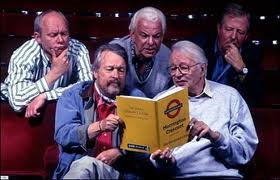
There are many institutions of British humour that have achieved international recognition – Monty Python, for instance, and for a slightly older generation, The Goons. This post is about a radio classic that has been running longer than both and is every bit as wonderful but perhaps not quite so widely acclaimed abroad. It’s called I’m Sorry I Haven’t a Clue and it has some interesting parallels with jazz.
It’s anarchic, silly, irreverent, sometimes very close to the knuckle of decency (amazingly so for a show broadcast before the watershed on the BBC). It was the first of its kind – a game show without scores, winners, prizes – often even rules. Essentially, it’s pointless (in every sense), just a vehicle for talented people to muck around and entertain.
It’s the lowth of stupidity. Perhaps you can see already where I’m going with this…
The show was an offshoot of an earlier thing called I’m Sorry I’ll Read That Again, which was doing madcap before Rowan & Martin got there. The premise for Clue was sheer laziness – the idea was to create a format where they could get the same kind of result without the bother of having to script and rehearse every episode. And of course it was, like so much in the late ’60s (myself included), hatched in the pub.
Hard though it may seem nowadays to appreciate, the idea of improvising comedy (in whatever framework) in front of a live audience was pretty revolutionary at the time and a lot of seriously talented comedians couldn’t hack it.
It was also, frankly, for the first few series, pretty rubbish, and the surviving crew – now well past their 40th anniversary of doing it – have admitted it was wobbly to begin with. Let’s say in all fairness that some of the earlier outings haven’t exactly stood the test of time (and didn’t really stand the test of the present at the time). But it found its legs pretty swiftly after that.
LICKS, TRICKS & TICS
Thing is that it’s successful because it’s “kind of improv” or “massaged improv”, rather than “white-knuckle anything-goes” improv. For one thing, the contestants had worked together for years in various permutations and could naturally play off each other.
As time went on, they established more and more traditions and in-jokes within the format. And not that there aren’t ad libs all over the place and a delight in attempts to derail the others, but they do get together a few hours in advance (where else but the pub?) to toss around a few ideas and work out a few little schemes.
For me it falls into the category of “homework applied very loosely”. Remind you of anything?
Bassist Chuck Israels has said of Bill Evans that he had a concept of “practised improvisation”. By which I think he meant that things didn’t happen the same way every time (oh boy they didn’t) but rather that there was a certain sense of loose format, some ideas that came up, which the rest of the band intuitively picked up on and could work with and riff off.
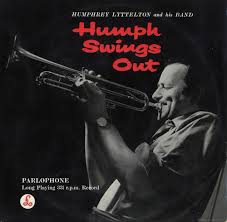
CHAIRMAN HUMPH
The guy soon chosen for Clue to be the sort of straight man in the middle of this gang of unruly wisecrackers was the late great Humphrey Lyttelton. Who was a masterful jazz trumpeter (Louis Armstrong loved him) and one serious post-war sex symbol.
He was chosen precisely because the comedians felt they needed a sort of jazz sensibility as a focus. He also exuded a patrician authoritative air, but was every bit as wicked and witty as the next man. (Some achievement when you consider the reprobate lineup he worked with…)
So his straight-man act wasn’t actually all that straight, and it was groundbreaking. Every time you ever see a compere complaining that the guests are useless, the script is awful, the set is cheap, the pay is lousy, grumpy because he’d rather not be there and dead-panning the audience into howls of mirth – Humph got there first. (Of course, he adored the show.)
As the bandleader of fate attempts to get paid by the bar manager of destiny, I have to leave the last line to Humph. He couldn’t do the last show he was scheduled for, but recorded a message to be broadcast for it: “I’m sorry I can’t do the show tonight, but I’m in hospital… Wish I’d thought of this sooner…”

PS I used to be a decent county-level Mornington Crescent player in my youth – I had an Elo rating of 30p. But the modern game is vicious – experience is no substitute for exhaustive research into the latest variations.
Computers have ruined the game, and Oyster Cards haven’t helped either.
* As modern analysis shows, this gambit leaves St Pancras en passant if the following player rolls a 5, and there are often enough delays on the Piccadilly Line to leave Queensway dangerously exposed to buses in the exchange variation. Especially when there’s a hotel on it and you’ve led a club to declarer’s full toss.


 Jason Lyon Music
Leave a reply to Chris Tandy Cancel reply