Here comes another blast of unashamed opinion. Looking forward to the comments!

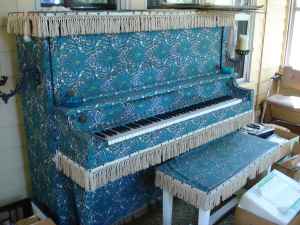
I recently got involved in a discussion about a certain piano at a venue. One chap, a knowledgeable listener and amateur tinkler, maintained that the instrument was rubbish and cited a friend of his who had performed on it and refused to touch it anymore. Another pianist and I countered by agreeing that it may not look up to much, but is actually a perfectly playable instrument that sounds pretty good and we’ve both had to deal with far, far worse.
In my experience, people who are really fussy about pianos are either from the very top flight of ability or the very bottom.
A top-notch concert artist is perfectly justified in being demanding about action, tuning and voicing. But others who complain are, as often as not, amateurs who are used to playing on electronic pianos and simply don’t have the chops or experience to cope with the wide variety of acoustic instruments that professionals have learned to handle.
Of course, I’d love to have a Hamburg Renner-action D, with twin-fuel injection and go-faster stripes, trucked into every venue I play and allowed to settle for a few days before the performance under the ministrations of a genius piano technician. I’d also love an infinity pool overlooking a bay in the Adriatic, a yacht moored in that bay and Gisele Bündchen’s phone number…
IT’S THE NOISE, NOT THE TOYS!
There are any number of anecdotes about brilliant musicians making Auntie Ethel’s glorified sideboard sound wonderful. Mozart did it, Liszt did it, Bud Powell did it, Bill Evans did it. So do you really think you’re justified in not coming out of your dressing room (glorified toilet) until they’ve flown in a Bösendorfer that’s precisely to your taste?
When golfer Phil Mickelson won the UK Open recently he said he was helped by using a new set of state-of-the-art clubs (product endorsement ahoy – but he’s entitled to it). But he’s him and you’re you – swap clubs with him and he’d still scratch the course and you’d still be gardening in the rough… (and yes, I know he’s a southpaw, but you get the point.)

You have to adapt your playing to the instrument.
If the tuning is really off, better to stick to linear, perhaps more percussive playing, rather than sonorous chording. If the action is tougher than you’re used to, focus your playing into a less florid style. Stuck notes shouldn’t really be a problem – they don’t sound bad, they just don’t sound at all. Just accept it and don’t let the missing note in the line trip you up. Really duff notes (absolutely nasty “doinkers”) can be quickly identified and either avoided or even – if you’re feeling adventurous or humorous – actually featured. If the sustain pedal is dodgy (or missing!) you’ll have to accept the limited colouration and get your legato from your hands. Actually, that’s where legato should come from anyway – the pedal should be treated as a tool, not a crutch.
I’m probably starting to sound like the sort of crusty old swine who used to whack your hands with a ruler when you made a mistake as a kid. Let’s try a different approach. Unless you’re Lang Lang or Jarrett, playing on instruments that don’t quite suit you or are downright crap is just a fact of life you’re going to have to accept as a working pianist. (Actually, the famous Köln concert was played on an instrument that Jarrett regarded as an absolute dog – he was also off his tits on painkillers and lack of sleep.)
You have to approach the situation as a challenge and look to create inspiration from adversity.
Now I’m not down on electronic pianos per se. They are wonderfully convenient, and I have a gigging rig just like everyone else. But I have always recommended to students who are doing their practice on an EP that they should book a couple of hours in a rehearsal room every now and then and get their stuff together on a real acoustic instrument.
If you’ve got the chops to handle a real piano, you’ll be able to play any keyboard – the reverse is not the case.
FINALLY, SOME TIPS FOR A GIGGING RIG
- Don’t be swayed by the fact that a keyboard has onboard speakers. It adds a huge amount of weight and bulk, and you’ll need an amp as well anyway. You can position this onstage to act as both amp and monitor.
- Keep your keyboard, stand, amp and gig bag completely ready to go at all times. When you finish a gig, make sure you’ve got everything, and when you get back home immediately repack ready to go all over again. Don’t care how tired you are – do it. Make it a habit.
- Get all the leads you’ll need to connect to most sound systems and keep them in the bag – never borrow them for another purpose. If you do, five’ll get you ten that you’ll forget to put them back and be left short on a gig.
- Always carry a spare transformer. They’re supposed to last for hundreds of hours but they do go phut unexpectedly, and I don’t fancy your chances of finding a replacement at 8.30pm while setting up. This has happened to me… When buying an EP, why not talk the shop into throwing in a spare to seal the deal? (They’ll always go for it.)
- Get some spare rubber feet for your stand. Those little buggers go missing all the time, and you’ll be chasing the instrument round the room. This has also happened to me.
- A blob of blutack should live permanently on your music stand. Flimsy sheet music can be just as wayward as those ****ing rubber feet!
- To be able to cope with any emergency situation, keep a plate/boundary mic (also known as PZMs) in the bag. I reckon the battery-powered versions with an XLR conversion are the best (but don’t leave the battery in the compartment between engagements). To mic an upright piano, tape it inside the lower panel (underneath the keyboard) roughly in line with the octave above middle C. For a grand, tape it to the lid roughly in the same lateral alignment, a little way back from the hammers, and close the lid.


 Jason Lyon Music
Leave a reply to Adam Cole Cancel reply