
Mention pentatonics in jazz and people will probably immediately think of Coltrane and McCoy Tyner. They might also think of trumpeter Woody Shaw, who developed pentatonic playing to an incredible level. Woody’s kaleidoscopic approach involved zipping across multiple tonalities on each chord by using collections of pentatonics. First things first though – for now, we’ll stay within the sound of the chord.
It is often taught that over any given chord we could use this, that or the other pentatonic. True enough, but it’s better to say that we should use this, that and the other pentatonic.
As Woody well knew (as did Trane and McCoy), you really unlock the potential of the pentatonic sound by assimilating the pentatonic scales as sets or families and constantly combining them. (They also realised that the structure implied by pentatonics is so strong that you can even deliberately play the wrong ones and it’ll sound good. But as I said, that’s for another day.)
A really useful quick way to remember which scales go with a minor 7th chord is to note that the roots form a II-V-I-VI pattern (a turnaround) based on the root.
We’re going to look at Cm7. The scales that go with this chord are:
- Dm pentatonic (II)
- Gm pentatonic (V)
- Cm pentatonic & Cm6 pentatonic (I)
- Aø pentatonic (VI)
The same scales also serve over EbD+4 – the relative major (Lydian and Dorian are in the same relative relationship as classical major and minor – Ionian and Aeolian). Learning the two chords as a pair is a very efficient way of practising, but be aware that each tone from the scales will have a different effect in the context of the relative major.
THE EXERCISES
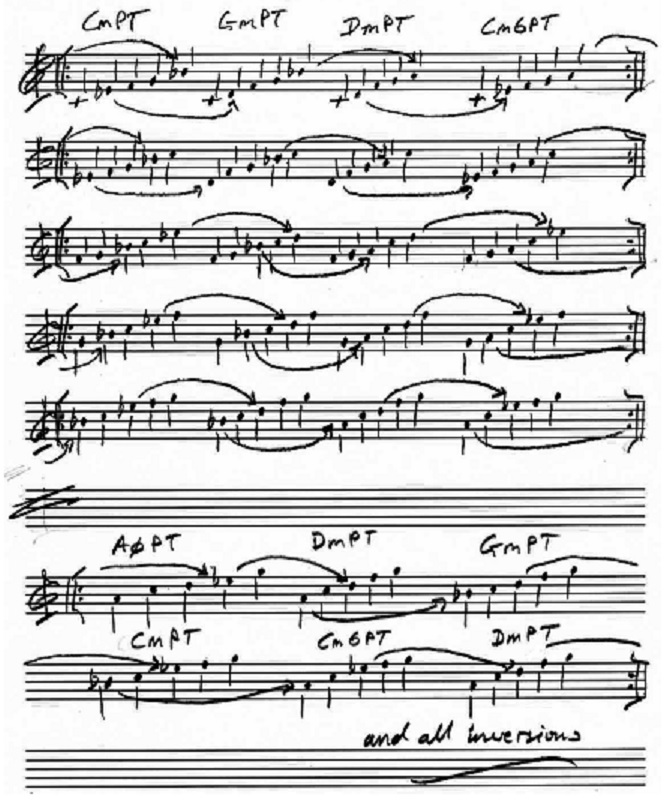
There are ways of connecting the pentatonic scales that fit over each chord by shifting just one note at a time. The exercises shown below demonstrate two examples of this – I’ve marked the notes that change to make things clearer. (Hopefully.)
Play through the exercises first with a Cm7 playalong, then with an EbD playalong, and keep your ears tuned to hear the different effects of the tones – in particular the A, which is the natural 6th in C (Dorian) minor and the #4th in Eb (Lydian) major.
You can then take the exercise through the other keys, and use them as models to devise similar ways of linking pentatonics over other chord qualities.
I’ve occasionally had people say to me: “Hey, you’re the guy with the pentatonic book, right? I didn’t hear it in that last number.” I can honestly reply by quoting Woody: “Just about everything I play is a pentatonic.” (But I’m constantly stringing bits of different ones together, sometimes inside the chord sound and sometimes outside it.)
I seem to recall that Woody also once said something along the lines of: “If you can’t play melodically with pentatonic scales you don’t properly understand them.” With any luck this article will give you a good kick-start on that road.
PS If you really can’t wait to get your outside stuff on, try doing the same exercise with C#m7 (and EΔ+4), then weaving between the two sets.
PLAY OVER Cm7 AND EbΔ+4
These ideas are extracted from my book Pentatonic & Hexatonic Scales in Jazz.


 Jason Lyon Music
Leave a reply to Interesting article on using Pentatonics .. and a Woody Shaw clip Cancel reply