
The key to using “upper structures” is to observe that simple major and minor triads exist in the upper reaches of altered dominant chords. These structures are often used by pianists and guitarists in chord voicings, but they are also very effective in solo lines.
Had you considered that you can play, for instance, an F#m triad over C7b9, or an F major triad over A7alt?
Using upper structures works on two levels, because not only are you nailing a lovely little clutch of some of the tastiest alterations in one gesture, you are also playing a clean triad – just not an obvious one…
The two commonest alterations to the dominant chord are 7b9 and 7alt. The scales that go with each are as follows:
C7b9

C7alt
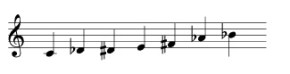
The upper structure triads that fit these chord qualities, along with the chord tones they describe on the home dominant chord, are as follows:
C7b9

C7alt

- Excuse the technically incorrect enharmonic spellings. They’re actually part of the deal when you’re dealing with an unexpected chord over another.
- Note that F# and Ebm triads fit both chord types.
- Other triads are possible, but not as useful because they don’t include enough interesting chord tones.
The way to internalise these in all keys is to think of them in Roman numeral notation. So Upper Structure #IV is a major triad built on the #IVth degree of the home chord (in the case of C, this is F#). Upper Structure bIIIm is a minor triad built on the bIIIrd degree (in the case of C, Ebm). And so forth.

SUMMARY
7b9 Upper Structures
- Major triads: bIII #IV VI
- Minor triads: bIIIm #IVm
7alt Upper Structures
- Major triads: #IV bVI
- Minor triads: #Im bIIIm
7b9 / 7alt Upper Structures (work over both)
- #IV bIIIm
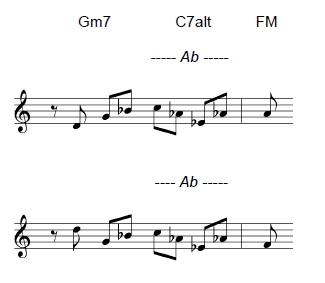
Focusing on these triads in solo lines hits the interesting chord tones over the dominant and allows for strong parallel structures between the II and V chords. The triads can also be made to resolve smoothly into a chord tone on the I chord. Some examples:
Gm7 C7b9 FM

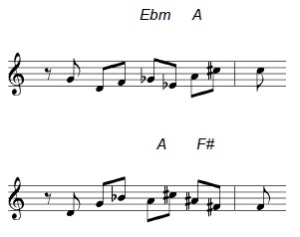
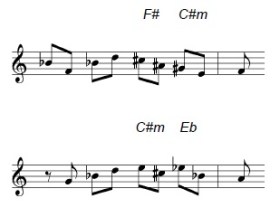
Combining two or more triads over the dominant becomes more useful in double-length phrases:

Note also that it’s common to imply first one, then the other dominant alteration on the same chord, even when the alterations don’t appear on the chart:
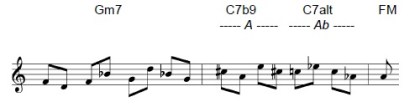
Oh, and any of these figures can be adapted for use over a minor II-V-I – just flat the 5th on the II chord and flat the 3rd on the I chord.
ADVANCED UPPER STRUCTURES
The altered chord-scale is a mode of the melodic minor scale. For instance, C7alt is the VIIth mode of Db melodic minor. This means that the upper structure triads that work over C7alt will also work over all the other chord qualities from that “parent” melodic minor scale.
Db melodic minor

The chords that go with this scale are:
DbΔm, (Ebsusb9), EΔ+5, (Ab7b13), Gb7+4, Bbm7b5, C7alt
The chords given in parentheses are less commonly used.
So you can use the relevant upper structure triads interchangeably over all these chords.
Ultimately, you really need to know all the chords from melodic minor as a set or family in every key. Do strive for this, but I’ll admit it’s a bit of a headful, so why not start by picking a few favourite upper structure triads over, for instance the half-diminished and tonic minor chords that appear in the standard repertoire you play.
As you look through the chord changes to a standard, decide in advance on certain upper structure triads that you’re going to drop in over particular chords.
For instance, over the first two chords of Stella by Starlight, you could preplan a D major triad over the Em7b5 and a C minor triad over the A7alt, and aim to hook the two together smoothly when you take your solo.
It’s probably least confusing to internalise thoroughly the upper structure triads on 7alt chords first and then learn the melodic minor chord families later. This is a quite demanding piece of book-bashing, but it’s well worth it – it will totally change the way you play.
Good luck with this approach, and feel free to contribute your ideas below.


 Jason Lyon Music
Leave a Comment